 Shenzhen Wintel Digital Technology Limited
Soft PVC Dripping Process: How Custom PVC Gifts Are Made
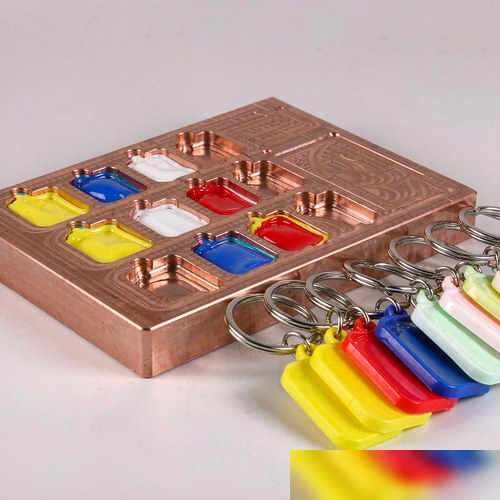
Soft PVC dripping — also called PVC dispensing or drip molding — is the process behind most custom PVC keychains, fridge magnets, luggage tags and 3D mascot figures. Instead of injecting molten plastic under high pressure, a liquid PVC paste is dispensed color by color into an engraved copper mold, then baked until it sets into a soft, flexible solid. This article walks through the full process as it runs on a factory floor, and explains what the process can and cannot do when you turn a logo into a physical product.
What the material actually is
Soft PVC starts as a white paste (plastisol) made from PVC paste resin, a plasticizer, a heat stabilizer and pigment. The plasticizer is what makes it soft — adjust the ratio and you move the hardness anywhere between Shore A 40 and Shore A 70. We use non-phthalate plasticizers (DINCH / DOTP), so finished items pass EN71 Part 3, RoHS and REACH, and can be declared phthalate-free for the EU and US markets.
At room temperature the paste stays liquid. Heat it to around 160–200 °C and it gels and fuses into an elastic solid that holds its shape permanently. That single property — liquid when cold, solid when hot — is what makes the whole dripping process possible.
The 8 steps from artwork to packed carton
1. 2D artwork and color separation. Your logo or drawing is redrawn as a clean vector file. Every color zone becomes a separate closed area, because each Pantone color is dispensed in its own pass. Line weight, color boundaries and PMS references are locked at this stage.
2. 3D modeling (free). For sculpted items — mascots, characters, figurines — we build a 3D model from your sketch, photo or reference image. You review proportions and color blocks on screen before any metal is cut. This service is free of charge.
3. Mold tooling. The approved design is CNC-engraved into a copper mold (aluminum for some large or flat designs). Copper is used because it transfers heat fast, which shortens baking time, and because it holds crisp edges better than steel at this scale. Tooling takes 3–7 days depending on how many cavities and colors the design needs. A well-maintained copper mold runs for tens of thousands of pieces.
4. Pantone color mixing. Each color is mixed by hand against the Pantone reference and checked under standard lighting. Because colors are mixed into the material rather than printed on it, they do not rub off or fade with handling — the color goes all the way through the piece.
5. Dispensing (the dripping itself). The liquid PVC paste is loaded into a multi-needle dispensing machine. The machine deposits each color into its assigned cavity in sequence — one color, one pass. Small runs and very complex layouts are still finished by hand with dispensing bottles, which is where the name “dripping” originally comes from.
6. Baking and curing. The filled mold moves through a tunnel oven at 160–200 °C. Small items set in tens of seconds; thicker 3D pieces need a few minutes. The paste fuses into one continuous solid — colors bond to each other, so a PVC keychain is a single piece, not layers glued together.
7. Cooling, demolding and trimming. After cooling, parts are pulled from the mold and excess flash is trimmed by hand. Edges are clean because the copper cavity is engraved, not cut.
8. Assembly and packing. Findings go on here: split rings, chains, lanyard holes, magnets, adhesive backs, phone-stand inserts. Every piece is visually checked and the attachment is pull-tested, then packed individually in polybags.
How product shape is formed — what the process allows
- Flat (2D) vs sculpted (3D). Flat designs are color blocks on one plane with a raised outline — the classic keychain look. 3D pieces are built as several molded parts assembled together, or sculpted as a single rounded body. Both come off the same dispensing process.
- Wall thickness. Minimum practical thickness is about 1.5–2 mm. Thinner than that and the paste will not fill the cavity evenly.
- Fine detail. Lines thinner than 0.3 mm and text shorter than 2 mm in height tend to disappear. We redraw artwork to survive tooling rather than letting it fail in production.
- Colors. Solid Pantone colors only, up to roughly 10–12 per design. Gradients, shadows and photographic detail are not possible in the material — they are added afterwards with UV printing or under an epoxy dome if you need them.
- Surface finishes. Gloss is standard. Matte, translucent, glitter, metallic, glow-in-the-dark and scented compounds are all available as additives to the base paste.
- Tolerance. Because filling and trimming are partly manual, expect ±0.2–0.5 mm. This is normal for the process and not a defect.
Soft PVC, silicone and rubber — picking the right one
We work in three materials and match them to the job:
Soft PVC — sharpest detail and the lowest unit cost at volume. Best for detailed logos, mascots, characters and large giveaway runs. Heat tolerance up to roughly 60–80 °C.
Rubber — more flexible and grippy, hard-wearing outdoors. Common for keychains, luggage tags and fridge magnets that get handled daily.
Food-grade silicone — for anything touching food or skin for long periods. Heat-stable past 200 °C, odorless, complies with FDA and LFGB. Used for straws, cup covers, kitchen utensils and premium corporate gifts.
Typical products made this way
PVC keychains and bag charms, 3D PVC figurines and mascots, fridge magnets, luggage tags, cup coasters and mat sets, PVC patches for caps and bags, shoe charms, bottle openers, USB flash drive casings and zipper pulls, badge reels, silicone and PVC wristbands.
Production parameters
| MOQ | 100 pieces per design |
|---|---|
| Mold tooling | 3–7 days, one-time charge, mold kept on file for 36 months (reorders skip tooling) |
| Sampling | 3-5 days after mold approval |
| Mass production | 7-15 days after sample approval, depending on quantity |
| Design service | Free 3D modeling, free artwork adaptation, Pantone (PMS) matching |
| Compliance | Phthalate-free compound, EN71-3 / RoHS / REACH |
| Shipment | To 50+ countries |
FAQ
Is soft PVC safe for children’s products?
Yes, when made with non-phthalate plasticizers. Our standard compound passes EN71 Part 3, RoHS and REACH, and a phthalate-free declaration is available on request.
Can you print a photo or gradient on PVC?
Not in the material itself — PVC dripping uses solid Pantone colors. Photographic detail is added afterwards by UV printing or under a clear epoxy dome.
How many colors can one design have?
Up to about 10–12. Each color is one dispensing pass, so more colors means slightly longer production time.
Who owns the mold?
You do. It is paid once, stored for 36 months, and reused free of charge on reorders.
What is the smallest detail that survives?
Lines of 0.3 mm and text 2 mm high. We adjust artwork to meet this before tooling.
Can PVC pieces be 3D?
Yes. 3D items are either sculpted as a single rounded body or molded as several parts that are assembled after curing.
